
Ann Widdecombe and the inconvenient business of political conviction
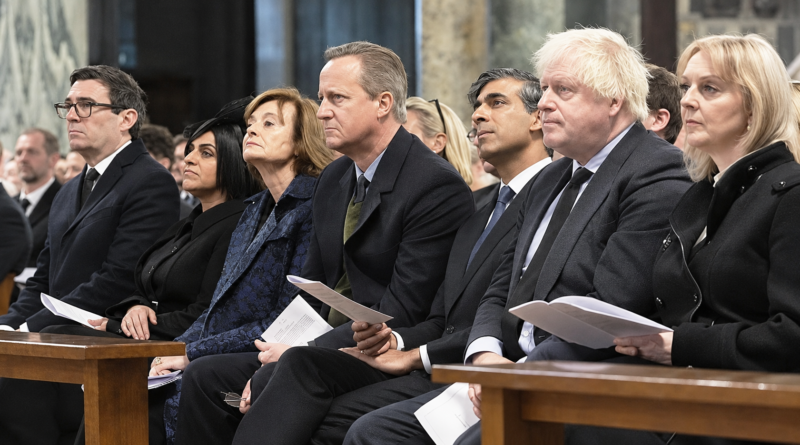
Among the hundreds who gathered at Westminster Cathedral on Thursday for Ann Widdecombe’s memorial service were four recent former UK prime ministers and a miscellaneous collection of politicians from across the political spectrum. On the one hand, it was touching to see such a good and diverse turnout for a fallen comrade, but it was also hard to ignore the irony that so many members of the political establishment had come together to honour a woman who had spent a good deal of her career making life uncomfortable for it.
One of Ann’s more commendable qualities, after all, was that, for all the years she spent in Westminster, she never seemed to have acquired that peculiar Westminster habit of answering an entirely different question from the one she’d been asked. Indeed, there were even occasions when one suspected that her colleagues would have been considerably happier had she done so.
You didn’t have to agree with Ann to appreciate this particular quality in her, and there were plenty of people, including even some of her fellow Catholics, who didn’t. But reflecting on her career – as so many have done this week – raises an interesting conundrum about British public life: what exactly is the difference between a politician who has convictions and a politician who merely seems to have positions?
Acquiring a political position is a fairly sophisticated business these days. There are people who can tell you what the public thinks, people who can tell you what the public might be persuaded to think, and yet more people who can advise you on how best to convey the impression that you’ve been thinking it yourself for some considerable time. Then, should circumstances change, there’s invariably some useful distinction to be made between what you actually said and what you apparently meant – and this is the essence of having a position on things.
Convictions, however, are altogether less convenient as they can make a serious nuisance of themselves at the most inopportune moments, and not least when there’s something like a ministerial vacancy in the offing.
Ann Widdecombe’s reception into the Catholic Church in 1993 following the Church of England’s decision to ordain women to the priesthood was hardly the sort of career move that would have occurred to your typical political strategist. Nor was her longstanding opposition to abortion likely to endear her to every section of the electorate, though it did bring her into an unlikely but profoundly influential and enduring association with Lord Alton (David Alton), then a Liberal Democrat MP. The two had quite different political backgrounds, but saw no great difficulty in working together on a matter about which they shared a profound moral concern.
In his eulogy at Westminster Cathedral this week, Lord Alton recalled how, in 1988, he and Ann had addressed a meeting in Bristol in support of their respective pro-life Bills, before returning to Westminster to vote on opposite sides of the House on another matter. She was also to become godmother to his youngest son. David recalled that, after one particularly vigorous disagreement, she had witheringly described him as her “favourite bleeding-heart Liberal” – which only went to show that intellectual and theological agreement on one moral question doesn’t oblige us to subscribe to an entire catalogue of similar opinions about everything else.
In the secular world, expressing a view about abortion, for instance, will quite readily lead people to make assumptions about your attitude towards immigration, climate change, the welfare state or even the BBC licence fee. This is a curious state of affairs for Catholics, as our intellectual tradition doesn’t readily lend itself to this sort of neat and stereotypical political packaging.
For us Catholics, there really is no theological inconsistency in being deeply concerned about the destruction of unborn human life on a Monday and equally exercised about the treatment of asylum seekers on a Tuesday. Where it does get difficult, though, is when one tries to find a political party in which both concerns can be expressed without somebody, somewhere, becoming distinctly uncomfortable.
Should that bother us? Well, it certainly didn’t bother Ann Widdecombe, and for very good reason. Catholic social teaching has never been an especially convenient resource for political parties – there are bits of it which politicians of almost every persuasion are more than happy to quote, and other bits which they would probably prefer Catholics didn’t read quite so attentively, or mention at all.
Central to this theological and socio-political tension is the Catholic Church’s understanding of conscience – a concept that even the most relaxed legislator approaches with more than a little reluctance. Ironically, we hear a great deal about conscience in Westminster, most usually when MPs are permitted a free vote on some particularly contentious piece of legislation whose implications are so far-reaching that party conformity is far less than guaranteed.
Unfortunately, this very terminology highlights a central difficulty with the exercise of conscience – implying as it does that on other occasions the exercise of conscience is somehow suspended.
Obviously, party discipline has a legitimate function and it would be difficult, verging on the impossible, to govern a country if several hundred individuals regarded every division of the House of Commons as an opportunity for a personal moral adventure. But there remains a question about where the ultimate responsibility for a political decision resides, and the answer cannot simply be with the Chief Whip.
Cardinal Newman’s description of conscience as the “aboriginal Vicar of Christ” is frequently quoted, although the implications of what he was saying are perhaps less widely appreciated. Newman wasn’t suggesting that whatever happened to be going on in one’s head had the authority of the Almighty. Conscience involves the recognition of a moral order which exists quite independently of our preferences. It needs to be educated and informed, and it can be horribly inconvenient.
Indeed, one of the more uncomfortable experiences of the Christian life is discovering that one’s conscience, properly examined, doesn’t necessarily endorse the opinion one has spent the past 20 years expressing with such enthusiasm.
Which brings us to St Thomas More, the Catholic Church’s patron saint of politicians and statesmen, yet a man whose career ended in such spectacular political disaster. In exercising his conscience, More may have lost his office, his influence, his liberty and eventually his head, yet he understood something about the nature of political authority which remains pertinent five centuries later. There were things the king had no right to demand of him, and the advantages of remaining in the king’s service could not alter that fact.
Thankfully, most politicians today aren’t going to find themselves contemplating execution as a consequence of falling out with the party leadership but – whilst the moral calculations are generally more mundane – they are often significantly less than straightforward. There must be plenty of occasions in political life when individuals persuade themselves that a small concession of principle is justified by the good they might subsequently be able to achieve if they remain in office.
But how many such concessions can one make before it becomes difficult to remember precisely what it was one intended to achieve in the first place? There is no particularly satisfactory formula for resolving these dilemmas. Politics requires compromise, and those who have never had to negotiate a difficult piece of legislation should perhaps be a little circumspect in passing judgement on those who have.
Nor should we confuse conviction with the inability to admit that we’ve made a mistake. There are few things more wearisome than the company of someone who regards every piece of evidence contrary to his own opinion as further proof of the inadequacy of everybody else’s thinking.
One of the prime attractions of Christianity is its eternal consistency, which in turn makes some fairly strenuous demands upon our intellectual humility, and not least upon the way in which we conduct our disagreements, something which seems to have received rather less attention in recent years than it deserves.
Spend half an hour reading the responses to almost any political controversy on social media and you’ll encounter an extraordinary number of people who appear to know not only that their opponents are mistaken, but also precisely what wicked motives have led them into error. How exactly they have acquired this remarkable insight into the souls of complete strangers is something of a mystery.
As Christians, we are always under an obligation to recognise the dignity of the person with whom we disagree, and perhaps this is where those of us outside Westminster also need to examine our own consciences. We’re forever complaining about the evasiveness of politicians, yet heaven help the minister who goes on television and admits that he doesn’t know the answer to a question. We demand that our representatives listen to the public, then all too often denounce them for performing a U-turn when they do. We also have a tendency to profess admiration for independent-minded MPs, although our enthusiasm for their independence diminishes rapidly when they exercise it in a direction other than our own.
Would we actually be terribly comfortable with a House of Commons full of people who possessed convictions? One suspects it would be a considerably noisier and less predictable place. Yes, there would be the occasional unexpected alliance, a good deal of frustration for the party managers and rather more occasions on which the electorate would be obliged to consider an argument on its merits. God forbid, there might even be the occasional interesting parliamentary debate.
For the Catholic, though, there is a deeper consideration. Political office confers upon an individual certain powers and responsibilities, but it confers no additional human dignity – the prime minister and the person who empties the wastepaper basket in his office are of precisely equal significance in the eyes of God. It’s a proposition to which most Christians would readily assent on a Sunday morning, although its practical application during the remainder of the week can prove somewhat challenging. What Christianity does, amongst other things, is to put politics in its place. Governments matter enormously, and the decisions taken in Westminster can transform or devastate people’s lives, but political power is a temporary arrangement, and there are obligations which precede it and will survive its passing.
Perhaps we should spend a little less time asking prospective politicians what they intend to do when they acquire power and rather more time asking them what they would be unwilling to do in order to retain it. The answers might tell us something useful about the people to whom we’re entrusting the government of the country.
Joseph Kelly is a Catholic publisher and public theologian