
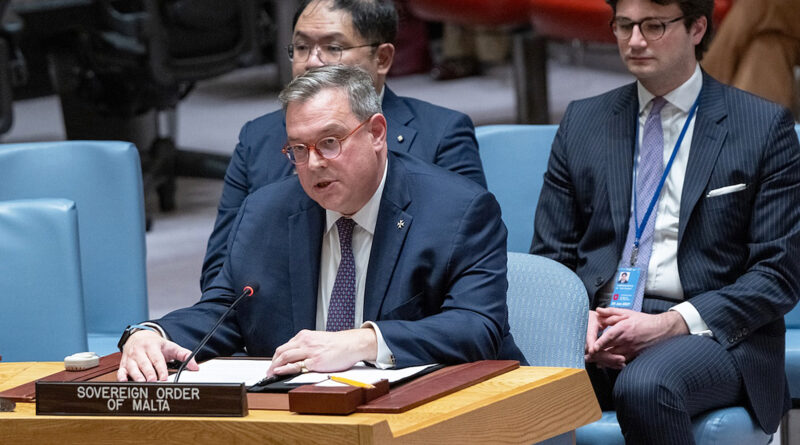
Order of Malta at UN Security Council open debate on emerging technologies and security
n 24 November 2026, the United Nations Security Council, under the Presidency of Latvia, convened a high-level Open Debate on Emerging Technologies and Security under the agenda item Maintenance of International Peace and Security.
Fra’ Nicola Tegoni, Member of the Sovereign Council of the Order of Malta, highlighted the transformative potential of artificial intelligence (AI) in healthcare, agriculture, education and sustainable development, while expressing concern over its growing application in military contexts, particularly the development of lethal autonomous weapons systems. Stressing that decisions affecting human life and the use of force must remain subject to meaningful human control, he called for concrete international action towards prohibiting such weapons, echoing the recent appeals of Pope Leo XIV.
Fra’ Nicola highlighted significant gaps in global AI governance, noting that only seven States had participated in all the international initiatives examined by the UN High-Level Advisory Body on Artificial Intelligence, while 119 States, mostly from the Global South, had taken part in none.
He called for a coherent, inclusive, and multilateral approach, ensuring equitable participation in developing international standards and regulatory frameworks. He further stressed the importance of protecting civilians and essential infrastructure, including food, healthcare and water systems, from the weaponisation of AI. Emphasising that emerging technologies must comply with international humanitarian law (IHL), he called for clear lines of responsibility throughout the AI life cycle, supported by transparency, traceability, human oversight, accountability and independent testing.
The Order of Malta also proposed considering an independent intergovernmental AI governance mechanism within the UN framework, drawing inspiration from the institutional model of the International Atomic Energy Agency (IAEA), to strengthen international cooperation, common safety standards and oversight. Fra’ Nicola underscored the need to ensure that developing countries and vulnerable communities could benefit from AI through greater access to technology, expertise and capacity-building. Concluding, he called for comprehensive multilateral governance, reaffirming that technological innovation must remain guided by international law, human dignity and the common good.
_______________________
The Sovereign Order of Malta is one of the oldest institutions of Western and Christian civilisation. A lay religious order of the Catholic Church since 1113 and a subject of international law, the Sovereign Order of Malta has diplomatic relations with over 100 states and the European Union, and permanent observer status at the United Nations. It is neutral, impartial and apolitical.
Today, the Order of Malta is active in 120 countries caring for people in need through its medical, social and humanitarian works. Day-to-day, its broad spectrum of social projects provides a constant support for forgotten or excluded members of society. It is especially involved in helping people living in the midst of armed conflicts and natural disasters by providing medical assistance, caring for refugees, and distributing medicines and basic equipment for survival. Across the world, the Order of Malta is dedicated to the preservation of human dignity and the care of all those in need, regardless of their origin or religion.
Founded in Jerusalem in the 11th century, the Order of Malta has a long history of service to the vulnerable and the sick. This 900-year history is reflected in its full name: Sovereign Military Hospitaller Order of St John of Jerusalem of Rhodes and of Malta. Since 1834 the Order of Malta’s government seat has been in Rome, where it is guaranteed extraterritorial rights.
The Order of Malta operates through 11 Priories, 48 National Associations, 149 diplomatic missions, a worldwide relief agency and 33 national volunteer corps, as well as numerous hospitals, medical centres and specialist foundations. It does not pursue any economic or political goal and does not depend on any other state or government.
The British Association of the Sovereign Military Order of Malta (BASMOM) was founded in 1875. The Association, as part of the OSJCT (Orders of St John Care Trust), participates in the operation of homes for the aged, in Lincolnshire, Wiltshire, Arundel, Gloucestershire and Oxfordshire. Currently there are over 60 homes, with some 3,500 residents, the Order being part of the organisation which is the largest provider of protected accommodation in the UK