
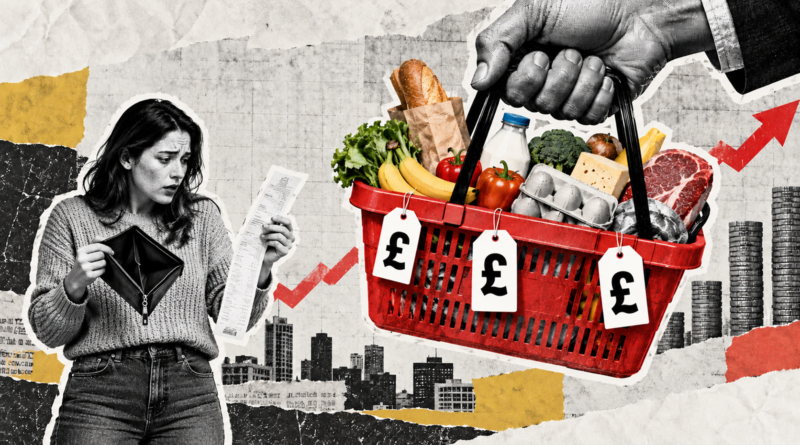
Stockpiling food and water may be sensible, but who is looking out for those who have nothing to spare?
For those of us old enough to remember it, there was something distinctly reminiscent of the old Cold War years about this week’s announcement that British households ought to start putting aside emergency supplies of food, water and other essentials, although thankfully we haven’t quite reached the point of being instructed to construct makeshift nuclear shelters under the stairs, or to shelter behind the kitchen table with a few mattresses and a portable radio.
Nevertheless, Prime Minister Andy Burnham’s endorsement of the Government’s new Be Ready campaign, which advises households to keep sufficient supplies to get themselves through at least three days of disruption, has understandably attracted considerable attention, not least because the very suggestion that the British public should prepare for the possible interruption of services we have long taken for granted is bound to create a certain amount of unease.
Burnham himself attempted to inject a little humour into proceedings, admitting that his own emergency provisions not only included water, baked beans and soup but also a supply of Twiglets. The inevitable discussion about whether a bottle of wine ought to feature on the official list – the advice being don’t backout in a blackout – also provided some light relief from what is otherwise a rather sobering message.
In normal circumstances, eccentric messaging like this might be dismissed as ill-advised scaremongering likely to lead to artificial shortages of the very items considered essential to survival in a countrywide crisis. But we live in neither rational nor secure times, so no doubt a UK-wide run on baked beans is probably already happening.
Joking aside, there lies a far more serious question about how prepared Britain actually is for any kind of a national emergency, and whether the government’s understanding of resilience in such circumstances extends much beyond encouraging those who have the means to do so to stock up on a few additional groceries.
There is, of course, nothing inherently unreasonable about asking people to take sensible precautions, especially when extreme weather, cyberattacks and the vulnerability of increasingly interconnected infrastructure are all capable of causing substantial disruption to everyday life, but there is a very flawed assumption here that everyone is equally able to respond to such events.
For a start, what exactly is someone who is already struggling to feed their family supposed to make of an instruction to purchase additional food that they must then put aside and not eat? And what about the elderly pensioner who has barely enough money to heat the house, the disabled person whose wellbeing depends upon uninterrupted access to electricity and medical support, or the growing number of households for whom the weekly shopping trip has become an exercise in deciding which essentials can be done without?
It is all very well talking about the importance of personal preparedness, but when a substantial section of the population is already living with a degree of insecurity that more fortunate households would regard as an emergency in itself, telling people to accumulate three days’ worth of supplies risks becoming something of an unfortunate contradiction.
Indeed, one might reasonably ask whether a society in which people are expected to stockpile food against the possibility of future shortages ought first to concern itself with those who are experiencing food shortages already.
This is not simply a question of economic inequality, although that is clearly part of it, but of the much broader issue of how we understand our responsibilities towards one another, and whether the increasingly individualistic assumptions that underpin so much contemporary public policy are actually capable of sustaining a society when things begin to go seriously wrong.
Over recent decades there has been a noticeable tendency for governments of differing political persuasions to place ever greater emphasis on individual responsibility, often presenting this as an admirable expression of personal freedom and self-reliance, whilst quietly overlooking the inconvenient reality that freedom of choice means rather little when the resources necessary to exercise it are simply not available.
In the context of emergency preparedness this creates the rather peculiar situation in which the better-off can congratulate themselves on having followed official guidance, whilst those who cannot afford to do so may find themselves regarded as insufficiently organised or responsible, despite having had no realistic opportunity to make the recommended preparations in the first place.
It is difficult to see how such an approach can be reconciled with any serious understanding of the common good. For we Catholics, human society is not simply a collection of independent individuals pursuing their own interests, but rather is a community of persons whose dignity and wellbeing are inseparably connected and whose obligations towards one another become especially important when circumstances place some members of that community at greater risk than others.
The principle of solidarity, which can sometimes sound like one of those rather worthy expressions that finds its way into ecclesiastical documents without necessarily troubling the everyday lives of those reading them, is actually a profoundly practical demand of us that we recognise the wellbeing of our neighbour as something for which we share a degree of responsibility.
Likewise, the preferential option for the poor is not merely an invitation to charitable generosity, important though that undoubtedly is, but a recognition that the moral legitimacy of social and political arrangements must be judged in considerable part by the treatment of those who possess the least power, influence and material security.
In other words, if we want to know whether Britain’s emergency planning is fit for purpose, we should perhaps spend rather less time examining the contents of comfortable households’ kitchen cupboards and considerably more time asking what will happen to those who have little or nothing in theirs.
The experience of recent emergencies ought to have taught us something about this, because one of the most consistent features of any major disruption is the way in which it exposes inequalities that were already present, but which ordinary circumstances had allowed the rest of society to overlook.
During the pandemic, for instance, it became painfully obvious that the experience of isolation was rather different for someone living in a spacious house with a secure income than it was for a family confined to overcrowded accommodation, whilst those whose employment or health circumstances offered little protection were frequently left facing the greatest uncertainty.
Similarly, when severe weather disrupts electricity supplies, the consequences for someone who loses access to television and the internet are hardly comparable to those faced by a person whose medical equipment depends upon a continuous power supply, or an elderly resident whose physical frailty makes prolonged exposure to cold potentially life-threatening.
The very same principle applies to food shortages, transport disruption and failures in communications, all of which tend to fall most heavily upon people whose existing circumstances have already reduced their ability to cope with unexpected difficulties.
What is particularly troubling is that many of those most at risk are also among the least visible members of society, living alone, experiencing poor health, lacking reliable family support or simply having become disconnected from the networks of neighbourly concern that previous generations might once have taken for granted.
And this raises another uncomfortable question, because whilst we are being encouraged to prepare ourselves materially for an emergency, have we given anything like the same attention to preparing ourselves socially and morally for the responsibilities that such an emergency would create?
A cupboard full of bottled water may be useful, but it will do very little for the elderly neighbour who has fallen ill and cannot get to the shops, whilst a well-stocked freezer is of limited value to someone who cannot afford to keep the electricity running or who has nobody nearby to offer assistance when essential services fail.
This is where the Catholic understanding of community becomes especially important, not because the Church possesses some miraculous solution to the practical complexities of emergency planning, but because it continues to uphold a view of human relationships that contemporary society has become increasingly inclined to neglect.
Across Britain, Catholic parishes remain connected to an extraordinary range of people and circumstances, from older parishioners receiving Holy Communion at home to families supported by food banks, charitable organisations and the often unremarked kindness of volunteers who quietly get on with helping others without expecting any particular recognition.
Such relationships are not necessarily impressive when measured against the bureaucratic structures of modern government, but they represent something that no emergency preparedness website can easily manufacture: an existing network of trust, familiarity and practical concern.
It would therefore seem entirely reasonable for dioceses and parishes to consider whether they might have a more deliberate role to play in helping communities prepare for emergencies, particularly by working with local authorities and established charities to ensure that those who are most vulnerable are not simply overlooked.
This need not involve elaborate schemes or unrealistic expectations of already overstretched clergy and volunteers, but could begin with the relatively straightforward business of identifying, with appropriate consent and safeguarding, those who may require additional assistance and ensuring that sensible arrangements exist for checking on them when circumstances become difficult.
Indeed, one might argue that knowing whether the elderly person who normally sits three pews from the front is safe and well is every bit as important a form of preparedness as remembering to buy another packet of batteries.
None of this, however, should be interpreted as an invitation for government to transfer its responsibilities onto churches, charities and local communities, because there is a considerable difference between recognising the importance of voluntary action and assuming that goodwill can compensate indefinitely for inadequate public provision.
Catholic teaching on subsidiarity is sometimes misunderstood as a general argument for reducing the role of the state, whereas its proper meaning is that decisions and responsibilities should be exercised at the most appropriate level, with larger institutions supporting smaller communities whenever circumstances exceed their reasonable capacity.
Applied to emergency planning, this means that whilst families and local organisations undoubtedly have responsibilities of their own, government remains under a clear obligation to ensure that essential infrastructure is protected, public services are properly coordinated and practical assistance is available to those who cannot reasonably be expected to provide for themselves.
If ministers are serious about encouraging the population to prepare for possible disruption, then it is surely not unreasonable to ask whether local authorities have adequate resources to support vulnerable residents, whether people dependent upon electrically powered medical equipment can rely upon appropriate contingency arrangements, and whether those unable to afford emergency supplies will receive meaningful assistance.
These are not particularly radical demands, nor are they an attempt to turn a sensible public information campaign into another tiresome party-political argument, but rather the sort of questions that ought to be central to any government initiative claiming to strengthen national resilience.
There is also a danger that an excessive emphasis upon individual survival will reinforce the very social fragmentation that makes communities less capable of responding effectively to emergencies in the first place.
When society increasingly encourages people to regard themselves as self-contained individuals, whose primary obligation is to secure their own comfort and wellbeing, it should hardly come as a surprise when collective difficulties expose a corresponding absence of shared responsibility.
Christianity offers a rather different perspective, grounded in the understanding that human beings are not merely consumers, taxpayers or independent units of economic activity, but persons created in the image of God and called into relationships of mutual obligation.
Christ’s identification with the hungry, the thirsty, the sick and the stranger in St Matthew’s Gospel is not simply a comforting religious image, but a direct challenge to any society that imagines it can measure its success without reference to the condition of those who are weakest.
The point is not that Catholics should disregard official advice, or that keeping emergency supplies is somehow an expression of selfishness, because taking reasonable steps to protect one’s family is clearly a responsible thing to do. Rather such preparations ought to be understood as part of a wider responsibility to others, rather than as a means of withdrawing from that responsibility when circumstances become difficult.
There is a certain irony in the fact that a society which has become increasingly sceptical of Christianity’s relevance to public life should now find itself discussing the importance of resilience, community cooperation and mutual support, all of which are closely related to principles that the Church has been defending for centuries.
Perhaps the real challenge presented by Burnham’s announcement is therefore not simply whether we can persuade people to keep enough food and water in their homes, but whether we can recover a sufficiently strong sense of moral responsibility to ensure that those who cannot do so are nevertheless protected.
A genuinely resilient nation is not one in which the fortunate have successfully insulated themselves against every conceivable difficulty, but one in which the vulnerable can face uncertainty with some confidence that they will not be abandoned.
By all means, let us follow the advice, put a few extra tins in the cupboard and make sure the torch has working batteries, because there is little virtue in being unnecessarily unprepared. But whilst we are checking our own supplies, it might be worth giving some thought to the person next door who cannot afford to do the same, or who may have nobody to turn to when ordinary life is suddenly disrupted.
In simple terms, for all the talk of national security, emergency planning and resilience, the most important question remains a remarkably simple one: when trouble comes, who will be looking after those who cannot look after themselves?
Joseph Kelly is a Catholic writer and public theologian