
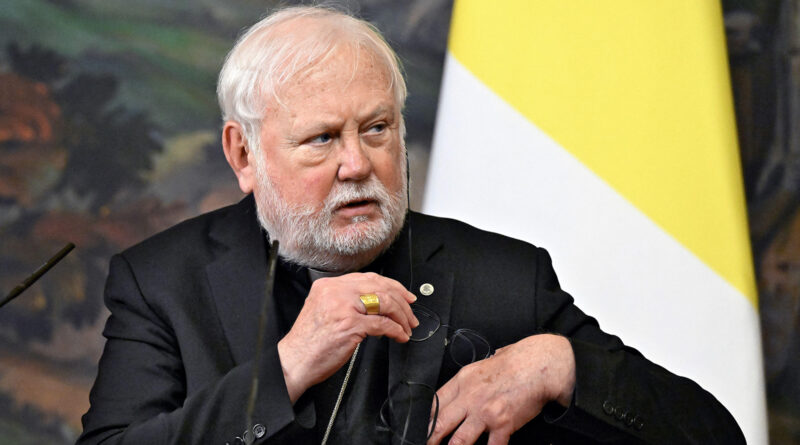
The Ukraine war must end before escalation acquires a logic of Its own
There was something unfashionably simple about the message delivered in Moscow on Tuesday by Archbishop Paul Gallagher, the Holy See’s Secretary for Relations with States and International Organisations. Standing alongside the Russian foreign minister, Sergei Lavrov one might have expected the archbishop to convey the Vatican’s position on the Ukraine conflict in the familiar language that characterises international diplomacy. But it was not to be the case.
“To be clear,” he said, “this war must end.” And you can’t get much clearer than that.
Only last month Archbishop Gallagher had been in Ukraine, visiting sites struck by Russian missiles and praying in Kyiv near a place where a Russian attack had killed more than 20 people, including children. So, his visit to Moscow was never going to be couched in niceties; four and a half years on since Russia’s President Putin annexed the Crimea and sent Russian troops into Ukraine in a bloody attempt to recreate lost Russian imperial glories, the Vatican shares the view of most of the world (and the majority of the Russian people) – that this pointless and utterly tragic conflict has to stop – and sooner rather than later.
The Russian authorities have been left in no doubt that the Holy See’s position remains that the conflict “cannot be resolved by military means”, and that conditions must instead be created for a political and diplomatic process; that international humanitarian law must be respected; and that it is necessary to stop becoming “prisoners of the wrongs of the past”. It has also been pointed out to the Kremlin that peace cannot be brokered without justice, so returning the region to any kind of normality is not just a case of sending the tanks and troops home but will require a very pro-active and conciliatory participation in a process of rebuilding broken lives and national infrastructures. In other words – from Putin’s point of view – peace must come, and a price must be paid for it.
“After more than four years of hostilities, the conflict continues to expand, the number of victims continues to grow, many families remain divided, and the material and psychological consequences of the conflict affect millions of people in Ukraine and Russia,” the archbishop said.
“For this reason, during our exchange, I reiterated the appeal of His Holiness Pope Leo XIV to end the hostilities and to begin authentic negotiations with the support of the international community.”
But Archbishop Gallagher also stressed that true dialogue “implies a recognition of the fact” that the longer the war continues, “the more difficult it will be to arrive at an adequate resolution, while the sufferings of the population continue to increase.”
Whilst his words were intended for the Kremlin, they also need to be heeded in the corridors of Westminster, where the military logic of the Ukraine war is moving steadily in the opposite direction. Just this week support for Ukraine took a steep upturn as Prime Minister Andy Burnham headed off to Kyiv with the blueprints for British-made components for the Scalp missile, a French version of the UK’s devastatingly effective Storm Shadow cruise missile – allowing Ukraine to produce the long-range weapon domestically. Until recently Russia itself was blissfully unaffected by the consequences of the conflict, but over the past month Ukrainian drone attacks on Russian energy and domestic supply infrastructures have intensified – bringing the war home to a population already unsettled by the loss of so many of its young men in the grinding conflict.
The pledge yesterday by Russia that it is going to mobilise another 600,000 young troops was intended as a retaliatory threat to the West, but at home this simply means that even more innocent sons are going to be dragged from their homes to die a pointless death for one leader’s arrogance – something that Moscow knows the Russian population won’t tolerate for very much longer.
One might have thought that this kind of ruthless insanity and dreadful waste of young lives might bring everyone to the negotiation table, especially when the Ukraine conflict is edging relentlessly towards an all-out war between nuclear powers and their allies, with all the catastrophic consequences that would have.
From the Catholic perspective Catholic teaching recognises Ukraine’s right to defend itself against aggression, but it also warns that a just cause does not make every means just. There’s no suggestion yet from the Vatican that other nations should abandon logistical and military support for Ukraine, but the time has surely come when we should be asking the question: where does escalation end, and what should the Catholic response now be to a situation where secular agencies have become locked into a conflict they aren’t showing any meaningful signs of resolving?
In these situations, a lot is often talked about the doctrine of the “just War”, which had its zenith during the two world wars of the last century, but is now all but extinct as a Catholic response to conflict. Pope Francis in particular wound down the just war theory throughout his pontificate, and his famous remark: “There is no such thing as a just war: they do not exist!” (18th March 2022 address to the International Congress promoted by the Pontifical Foundation Gravissimum Educationis) is generally cited as the moment the ‘Just War’ theory expired theologically.
Today, Catholic theology has something particularly important to contribute to discussions about conflict resolution because it refutes two morally inadequate positions: on the one hand there’s pacifism masquerading as neutrality – the suggestion that because war is terrible, Ukraine should simply submit to Russian demands. Conversely there’s the opposite position, that because once one side possesses the justice of the original cause, virtually any further military escalation becomes morally legitimate.
In the case of the Ukraine conflict the starting point is that Russia invaded a legitimately constituted country, and the Catechism of the Catholic Church explicitly recognises that governments cannot be denied the right of lawful self-defence once efforts for peace have failed. A country does not acquire a Christian obligation to surrender when its territory is invaded, its citizens killed and its political independence threatened.
However, this also does not give an attacked country the right to conduct its defence by any and every means possible, and Catholic tradition distinguishes clearly between the justice of entering a war and the morality of how that war is conducted subsequently.
“The mere fact that war has regrettably broken out,” the Catechism says, “does not mean that everything becomes licit between the warring parties.” (CCC 2312–2314)
It’s a sentence that ought to be displayed in every defence ministry in Europe, and in a few parliamentary committee rooms too, as it leads to the demand for political leaders to consider whether the use of force will produce “evils and disorders graver than the evil to be eliminated”.
And that’s where the real problem with the Ukraine conflict arises. What began as a military contest between Ukrainian and Russian troops along a front line has gone the way of most wars – the increasing involvement of other parties and the motivations for supporting or contesting military action have spilled the action into a much wider conflagration that begins impacting innocent civilians far more than it harms the combatants. What started in effect as a regional incident now involves missiles travelling hundreds of miles, drones striking energy infrastructure, cyber operations, intelligence supplied by outside powers, weapons manufactured across national borders and threats being directed against NATO countries.
Whilst each escalation gets justified as a response the previous one, the outcome is a pattern of escalation that – if not halted – becomes self-sustaining. In such a scenario no-one actually needs to decide to go to war, but it’s arrived at anyway by building a bonfire of seemingly justified small responses to escalations that apparently cannot go unanswered.
Such human behaviour is what creates wars that apparently no-one wants, no-one seems to have been responsible for, and no-one seems empowered to stop. One only has to look at Ukraine to see exactly this pattern of defective human behaviour at work. Archbishop Gallagher may not have said as much in Moscow, but what the Catholic Church has long-since recognised is that the human person has a fundamentally ‘fallen’ nature, so it’s suspicion of military escalation is rooted in a bleakly realistic understanding of human nature – that political leaders aren’t always rational, perfectly informed or immune from pride.
In contemporary society deterrence strategy often depends upon an extraordinarily optimistic anthropology, assuming that leaders will interpret signals correctly, accurately distinguish bluff from intention, remain calm under enormous pressure, resist domestic political humiliation and calculate precisely how far they can push an adversary without provoking a calamitous response.
Sadly, that’s not really where the human person is right now, and we’re still a very long way from moral aspirations of society being governed by courage and reason. From Cain onwards, Scripture understands how bloodshed reproduces itself.
Pope Leo XIV put the point plainly earlier this month when discussing casualties in Ukraine and Russia: “War only breeds more war.” It was time, he said, “to stop the spiral of violence and make room for diplomacy and dialogue”.
The word “spiral” is significant, as there’s now a very urgent need to ask the question: where does the spiral end? If Russian and NATO personnel start killing each other directly, will each side calmly say that matters have gone far enough? Will reaching for the nuclear button really be seen as a retaliation too far? One might pray so, but there’s been little evidence of rationality in this conflict so far.
It might be reasonable to ask Archbishop Paul Gallagher exactly what he sees as the route through to a deescalation of the Ukraine conflict. Yes, of course, this pointless and tragic military campaign needs to end now before it runs out of everyone’s control, but what might be the actual mechanisms for unlocking flawed human natures and the reciprocity dilemma? He’d probably answer that diplomacy is a central precursor to peace – in fact he referred to this succinctly in his statement after the Moscow meeting.
He described his conversation with Lavrov as “constructive” and stressed that “in an international context marked with deep tensions, meeting and discussing matters together with clarity already constitutes a sign of responsible action.”
“Dialogue does not eliminate differences of opinion or approach, but it does prevent incomprehension and suspicion from becoming the only language available to us,” the archbishop said.
It’s worth considering here the Hebrew word ‘shalom’, which informs the Christian conception of peace. Shalom means something richer than the absence of gunfire, it’s a peace connected with justice, right relationship and human flourishing.
St Augustine understood peace as the “tranquillity of order”, and Archbishop Gallagher himself has consistently spoken not simply of peace but of a just and lasting peace – a position which involves the profound acknowledgement of a meaningful and consensual peace, rather than one imposed by acting agencies. This is the essence of Catholic teaching on subsidiarity, that the peace brought to the people of Ukraine cannot be settled morally over the heads of its citizens, nor can its sovereignty be traded by greater powers – there have been too many examples in recent history of warring nations bartered for peace with catastrophic consequences.
So where is the way forward? Well, if the nuclear chasm is to be avoided, all those involved in prosecuting and supporting the Ukraine war will have to accept that brokering a peace treaty is the only rational way forward. They will also need to accept that a meaningful and lasting peace is not something that comes after the strategic and financial benefits of promoting a conflict have exhausted themselves but is something that is arrived after as a positive and humanitarian alternative to endless death and destruction.
But perhaps most difficult of all, it will require all parties to embrace perhaps the most politically scandalous elements of the Gospels, Christ’s command to love one’s enemies. Such a position requires political leaders to see the Ukrainian conscript killed in a trench on a par with one killed in a Russian trench; that all human beings are made in the imago Dei – the image of God.
At the deepest level this was perhaps the greatest outcome of Archbishop Gallagher’s visit to Moscow – because above all else continued diplomacy deprives people of the oxygen of hatred. Whilst it moves quietly in small steps, diplomacy has the powerful capacity to achieve limited agreements between even people who mistrust each other profoundly. It also has the capacity to broker agreements in which nobody needs to feel vindicated, nor to feel that they have been diminished.
“Blessed are the peacemakers,” Christ said in the Sermon on the Mount, “for they shall be called children of God.” Amen to that. Please do keep Archbishop Gallagher and all who work for peace in your prayers.
Joseph Kelly is a Catholic writer and public theologian
_______________________________________
Pic: Moscow, Russia. 25th Aug, 2026. Archbishop Paul Richard Gallagher, Vatican’s Secretary for Relations with States, speaks to the press following the talks. Dmitry Dukhanin/Kommersant Photo/Sipa USA