
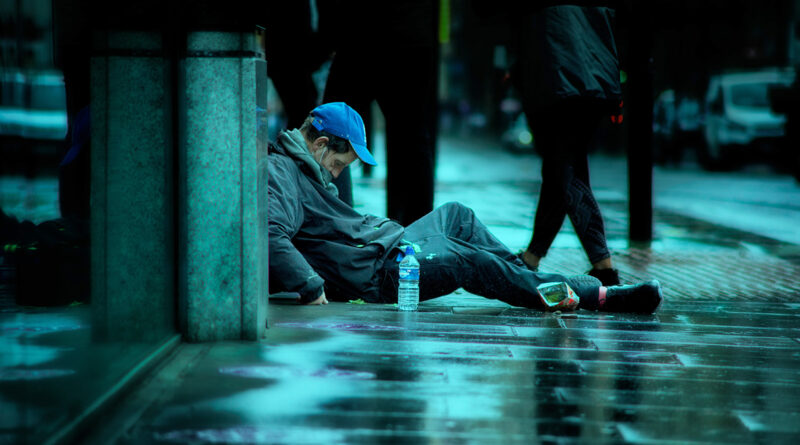
Does government’s early commitment to ending homelessness signal at last a new way of doing politics?
Quite a few things have been learned from Andy Burnham’s first week as prime minister, not least that the new incumbent has a particular determination to reconfigure public perceptions about how politics in Britain is going to be conducted in the months – and probably years – ahead. Doing away with the traditional Downing Street lectern for his first public speech was clearly intended to signal a more engaging and affable relationship with the public space; equally his ruthless dismantling of his predecessor’s Cabinet left no-one in any doubt that he’s also not averse to taking difficult and challenging decisions.
The slew of policy announcements that followed were welcome enough: ending rough sleeping, capping bus fares, removing VAT from electricity bills, tinkering with tax thresholds, cuts in business rates for pubs and clubs and the dispersal of political power from Westminster to the regions. Announced on his very first day in power, the pledge to end rough sleeping came with a promise to allocate an additional £340m to the cause, something that few people would take umbrage with. As anyone who’s walked more than a few yards in any of the UK’s urban centres will know, sleeping on the streets is as commonplace as it ever was, and perceptions that it’s increasing are growing.
As best as it’s possible to measure such things, the government’s own figures published in February this year have estimated that the number of people sleeping rough across the UK on a single night in autumn 2025 was 4,793, exceeding the previous peak of 4,751 in 2017. This is the fourth annual increase in a row, increasing 3% since 2024, and 171% higher than 2010 when the government’s snapshot approach was introduced.
Three quarters of all people sleeping rough are in London and the South East, whilst the largest regional increase was in the North West of England, rising from 367 in 2024 to 441 in 2025 – an increase of 74 people or 20%. The snapshot also found that the majority of people sleeping rough in England are male, aged over 26 years old and from the UK, and this is similar to previous years.
Whilst these figures may not reflect public perceptions of a nation being overwhelmed by sleeping bags in doorways, the best research that’s available has always pointed to rough sleeping as a complex and nuanced problem that is as much about transitory circumstances as it is hard-wired destiny. Fundamental problems arise with the very definition of phrases like ‘rough sleeping’ and ‘homelessness’, and the issue certainly can’t be resolved without reference to the many and unexpected circumstances that can result in a person or persons finding themselves without a roof over their head.
Most initiatives to resolve rough sleeping tend towards the provision of accommodation, on the not unreasonable grounds that once a person has been housed, they’re off the homeless stats.
When Andy Burnham became mayor of Greater Manchester he not only prioritised ending rough sleeping but for nine years donated 15% of his annual £118,267 salary to tackle homelessness.
At first his efforts appeared successful, with figures falling from 268 people in 2017, to 90 in 2021 – though there are those who say this was due to wider government initiatives to get people off the streets with COVID approaching. Since then Manchester’s positive and people-friendly outlook has made it a favourite destination for refugees and other incomers, clouding established definitions and characterisations of homelessness.
In February last year a growing refugee tent village in Manchester’s St Peter’s Square had become such a political issue that the city council took legal action to retake the land, handed people in the encampment plastic bags for their possessions and threw their tents into a bin lorry.
In many respects the St Peter’s Square camp encapsulated both the extreme ambiguities that the general public have long had towards homelessness – the tragic war veteran or young student vs the unwelcome and burdensome stranger in our midst – and the very same difficulties that lawmakers have in distinguishing and ameliorating different categories of homelessness.
During the St Peter’s evictions it was said by homelessness campaigners that Manchester City Council had failed in its statutory duty to offer relevant and appropriate support to those living in the camp. Some had been approached, assessed and moved towards temporary accommodation, whilst others had simply moved on and set up new tents elsewhere, mostly provided by other homeless support groups who believed that handing out tents and sleeping bags was far better than leaving vulnerable people to wander the cold, February streets of Manchester.
Whilst homelessness has high profile status because it is human poverty and vulnerability visible to us all on our streets, it’s hard to get action or remedies because – compared to other social concerns such as health, welfare and social care – the numbers of people affected are relatively small and the cost of resolution extremely high. Last year alone London councils were reported to be spending some £5.5m a day on acquiring 1,200 homes and providing intensive support to just 3,000 people – which certainly puts Mr Burnham’s £340m funding pledge into perspective.
In the most simple terms – if you exclude the very small number of people for whom the itinerant life is a choice – the only route to resolving homelessness is to provide stable, affordable accommodation, intense peer support and a stable, long-term job. Until all that is available – and in a co-ordinated way – even the most determined initiatives to get people off the street are going to be short-lived solutions – and sadly that’s what the figures also show, and that’s also why Mr Burnham’s initiatives in Manchester showed such early promise, but ultimately failed to reverse the numbers.
It’s rarely mentioned but when the COVID pandemic hit local authorities were given just three days to move all people sleeping rough or living in shared hostels across the UK into emergency accommodation that would allow them to socially distance or self-isolate if needed. It was an unprecedented challenge, but within days housing secretary Robert Jenrick was claiming that rough sleeping in England had been cut by 90%. This exact figure was disputed by some, but it was agreed that rough sleeping had all but disappeared. Pre-COVID, an estimated 4,266 people were sleeping rough in England. But under Everyone In, an estimated 14,610 individuals were placed successfully into emergency accommodation (a larger figure which included those sofa surfing, newly homeless and those staying in unsuitable accommodation.)
COVID may have been an extreme circumstance, but it demonstrated both what could be achieved in a very short space of time if the legislative will was there, and the weaknesses of assessing homelessness which were obviously underestimating the real extent of the problem. It was also significant that COVID changed the homelessness problem from one of exclusion, stigma and societal prejudice to one of a population-level health crisis which served to unlock routes to resolution that were previously unavailable or considered unacceptable.
Whilst the pandemic may have evaporated the myth that little can be done to eliminate homelessness to any meaningful extent, broader economic and political factors come into play when one confronts the need to sustain such a change over time. Throwing large numbers of vulnerable people into hotels, hostels and requisitioned houses to offset a pandemic is one thing, driving economic solutions that will increase the availability of housing and sustain long term employment opportunities is quite another.
As the COVID pandemic began to grip the UK the Bank of England issued a dire warning that the country was about to slide into its deepest economic recession in 300 years, with domestic output plunging more than 30 per cent – the fastest and deepest recession since the ‘great frost’ in 1709, and this coming on the back of more than a decade of austerity politics. The catastrophic upheavals caused by the pandemic also destabilised both the rental sector and the jobs market, exacerbating the difficulties of many of those already clinging to domestic stability. It is estimated that more than 250,000 people have been driven to potential homelessness as a result of COVID, and changes to rental laws that came into effect at the time just pushed this problem further. Economic uncertainties and turbulence blown up as a consequence of wars in Ukraine, Iran and elsewhere have also deeply destabilised the jobs market, meaning that those most in peril of ending up on the streets are far closer to catastrophe than ever before.
Pope Saint John Paul II described the housing crisis as a “serious problem” that “has negative consequences on the individual, family, and social levels.” In his Encyclical Letter Sollicitudo rei socialis, he wrote, “The lack of housing is to be considered a sign and summary of a whole series of economic, social, cultural, or simply human shortcomings.”
In these early days of his new government, priorities will be heaping up at Mr Burnham’s door, some of which can be dealt with far more easily than others. Turning around a desperate economic landscape that has been blighted by years of fiscal and legislative neglect will be a mammoth, long term task but taking action on the provision of safe, long term accommodation for the most vulnerable is perfectly achievable, and even at short notice.
Just a few paragraphs into his first promise on Monday Mr Burnham talked about creating a government that would be “investing in people’s success rather than paying for failure.”
Over recent decades many Catholic and other faith charities and homeless organisations have worked tirelessly within endlessly shifting constraints to provide meaningful, lasting services and routes to stability for those who have found themselves homeless. For its part, successive governments have tended to treat reducing the visible problem of homelessness on our streets as a knee-jerk response to voter unrest rather than an intrinsic indicator of failing economic and political policies that needs to be tackled strategically and meaningfully.
Reversing such thinking in a society beset by so many economic and political challenges may seem like an impossible task, but it really requires no more than the adoption of a political agenda based on the established Catholic principle of a ‘preferential option for the poor’, of a renewed commitment to fixing the structural causes of poverty, while providing unquestioning charity to those who need it. Out of such a priority, economic stability and personal wellbeing flourishes.
To tear down and completely rebuild a national vision, and to restructure an economy that has become deeply embedded in fiscal decline is no small ask, but starting out on day one with a stated determination to reach out and help the most vulnerable is a hopeful start of the kind that we’ve not heard in these parts in a very long time. We’ve not exactly been living through the most positive of political times, but perhaps at last some light is coming over the horizon?
Joseph Kelly is a Catholic writer and public theologian