
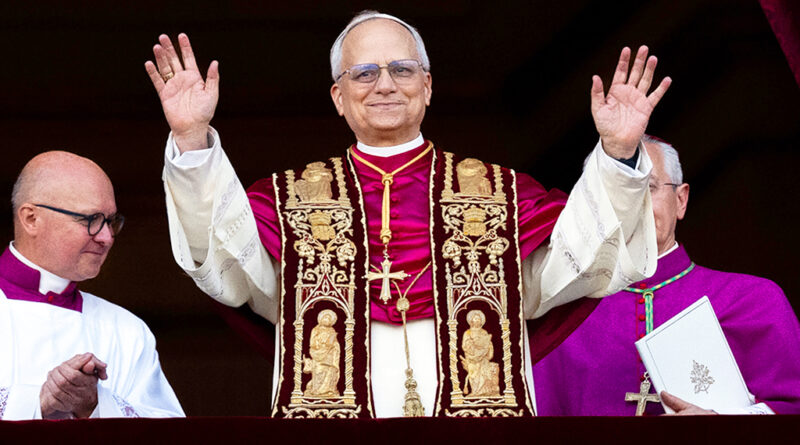
Is US-born Pope Leo XIV about to redefine the role of the Church in the modern world?
So there it is, we have our first American pope, a committed missionary who began his long and remarkable journey in Chicago’s ethnically and economically diverse South Side suburb (where he was affectionately known as ‘Father Bob’). Other famous names who grew up there include Barak and Michelle Obama, Jesse Jackson, Louis Armstrong, Bo Diddley, Quincy Jones and Lou Rawls. Traditionally a poor area comprising mainly African Americans, time has gentrified many of the South Side neighbourhoods and new wealth flowing in has made it one of the most diverse and creative areas of the city.
The young Robert Prevost grew up in the Bronzeville District which in 1945 became known as the ‘Black Metropolis’, after the publication of an anthropological and sociological study of the African-American urban experience in the first half of the 20th century. Black Metropolis – A Study of Negro Life in a Northern City by St Clair Drake and Horace R. Clayton was a groundbreaking text and is nowadays respected as one of the foundational texts in the study of the African American experience.
Central to the book’s conclusions was an overwhelming awareness that “staying alive, having a good time, praising God, getting ahead, and advancing the race” was a proven formula for a healthy and tolerant society.
Whilst the book is grounded firmly in the language and theological limitations of its time, it provides a fascinating insight into the cultural and spiritual landscape in which our new pope grew up, and undoubtedly helped shape his ideas and intentions.
In these first few hours after his election, there has been plenty of scrabbling around for the writings and commentaries of Robert Prevost and much – perhaps far too much – has been made of his past opinions as each commentator has inevitably sought to bend narratives to their own agendas. To some he’s a determined liberal reformer who will push the work of Pope Francis even further whilst others have grasped at the threads of orthodox sympathies in the hope that Leo XIV might restore what have been lamented as lost past certainties.
In the melee, two words predominate – ‘centerground’ and ‘listener’, not that these really give any meaningful clue to the likely direction of this particular pontificate. Of course ulimately the Holy Spirit guides, but this is also a role where the job really does dictate the man. For the cardinals who voted, it does seem that after several decades of change, controversy and divisions there was a clear decision towards longevity and moderation, and even hopefully towards a bringing back together of factions within the Church that have become destructively disparate. In this respect a centerground listener was the sensible choice, and Cardinal Prevost also brings with him an outstanding track record as an outreacher and arbitrator.
Much has been made of his choice of name – it’s tradition for pontiffs to select one that reflects their intentions, and for people to make similar assumptions about their choice. As one of the longest-serving popes in history, Pope Leo XIII was renowned for his intellectualism and in particular his pronouncements on matters of social justice, which are these days generally referenced as the starting point for the modern concept of Catholic Social Teaching. His 1891 encyclical Rerum Novarum was certainly the first indication that the Church might have an agenda towards the rights of workers. Leo’s radical thought was that the Sin of Adam and Eve may have condemned us to rediscovering God through a lifetime of physical labour and toil, but he challenged the presumption of wealthy Victorian industrialists that God intended this also to be a life of misery, indignity and exploitation. For Leo this was a theological step too far, and his arguments earned him the popular title of the “Pope of the Workers” or the “People’s Pope”.
Leo XIII may have believed that political sociology ought to be a preoccupation of Catholics, but it should also be pointed out that whilst Leo worked hard to reconcile the Church with the working classes, he was no Marxist or socialist and it’s something of a stretch to argue that Leo XIII was specifically a champion of workers’ rights. In his day, Leo was far more concerned with the Mariology of the Church – issuing no less than 11 encyclicals on the rosary – and devoted much of his papal energies to reviving the teachings of Thomas Aquinas. He was also an influential and tireless global diplomat who influenced the policies and social fabric of many countries, including the United States – a country he admired greatly.
Whilst many are speculating that this new pontificate will be shaped by the legacy of Pope Leo XIII, it’s far more likely that Robert Prevost will actually deliver us a renewed and more complete understanding of the complexity and spirituality of his illustrious namesake. If his homily at this morning’s Mass in the Sistine Chapel is anything to go by, there is definitely going to be a renewed focus on historic and traditional dimensions of the faith, but set within a contemporary context – thus we’d see a Church that is rediscovering the beauty of its liturgical past as a mechanism to engage with modern society and its problems, rather than as a defence against, or antidote to, them.
His Holiness spoke this morning of the Catholic Church as needing to be: “a city set on a hill, an ark of salvation sailing through the waters of history and a beacon that illumines the dark nights of this world.”
Even today he said: “there are many settings in which the Christian faith is considered absurd, meant for the weak and unintelligent. Settings where other securities are preferred, like technology, money, success, power, or pleasure.
“These are contexts where it is not easy to preach the Gospel and bear witness to its truth, where believers are mocked, opposed, despised or at best tolerated and pitied. Yet, precisely for this reason, they are the places where our missionary outreach is desperately needed. A lack of faith is often tragically accompanied by the loss of meaning in life, the neglect of mercy, appalling violations of human dignity, the crisis of the family and so many other wounds that afflict our society.”
Leo’s mention of “missionary outreach” not only reflects his own life’s journey, but also defines quite specifically what this pontificate is going to expect of the Catholic community in the years ahead. During his many years in Peru, Leo was acknowledged as a uniquely unifying and conciliatory voice in a country not only deeply divided politically, but torn apart theologically by the tensions between liberation theology and fundamentalist orthodoxy. In many respects this makes him well placed to engage with some of the profound problems affecting the world today.
As an Augustinian – he joined the order at the age of 20 – his calling has not been to withdraw from the world, but to travel as a mendicant to aid the poor and serve as a teacher. As the prior of the worldwide Augustinian order he oversaw some 50 communities spread across the world, from the USA, Europe and Africa to South Korea, Japan and Papua New Guinea.
The Augustinian vocation derives from a unique concept of a four-tiered community that vindicates Christianity – the Church, the state, the City of Heaven, and the City of the World. First described in The City of God, a book of Christian philosophy written in Latin by Augustine of Hippo in the early 5th century AD, the premise is that the Catholic Church can work with the state (a political community that should be dedicated to justice and the human good) in order to create the City of Heaven – those predestined for salvation, and set against this is the City of the World – the domain of the false gods of money, materialism and greed that leads to damnation.
To the modern mind, Augustine’s utopian worlds may seem outplaced and anachronistic, but the modern Augustinian remit remains one that believes that theologians, the faithful and political society can be brought together as one unit for the common good, and the real enemy of peace, prosperity and human dignity is relativism and the worship of the false gods of power, wealth and privilege.
Looked at in this light, the pontificate of Leo XIV is unquestionably going to be an interesting and challenging one for everyone involved. The notion of building positive alliances with legislators, the laity and the Church is one that has achieved results and has ameliorated many injustices around the world, not least in Peru where Pope Leo has done much arduous and committed work over recent decades.
Turning these alliances against the evils of corruption, corruption and greed is undoubtedly a beneficial alliance to most, and especially the poorest and most vulnerable in society, but the real challenge that Pope Leo will have to confront in the years ahead is to separate out the good actors from the bad.
In a world where waging wars, hoarding resources and decimating innocent populations has become intrinsically connected to commerce, affluence and power, the Catholic Church will need more than ever to engage with the more complex and potentially compromising debates of the modern age, but we will also need to be able to separate the sheep from the ravenous wolves (Matthew 7:15).
When asked why she didn’t baulk at dealing with despotes and dictators, Mother Teresa of Calcutta always used to defend that she would accept help and money from anyone if bought a loaf of bread for the dying. Which is all very well, but on the broader global stage the theological challenges are going to be somewhat more complex. In a world where mistrust, suspicion and avarice are growing dangerously, our new pontiff is going to have lead the Church through some very tricky undergrowth, especially as it’s very likely that the Church may be the only arbitrator left for common sense prevailing between angry and irrational protagonists. But it’s exactly where this pontificate is going to have to tred.
As Pope Francis said at a meeting with university students in Lisbon in 2023: “Sometimes in life we have to get our hands dirty, so we don’t get our hearts dirty.”
It’s very early days yet, but one does get a sense that in this respect Pope Leo XIV could be exactly the pope we need for the difficult times ahead. Please do keep him in your most earnest thoughts and prayers as he prepares himself for the journey.
Joseph Kelly is a Catholic writer and public theologian