Caritas Nepal: Situation is difficult but Church working to support people
The death toll in Nepal has now risen to at least 547 people, with 1473 injured and more than 900 still missing, two days after devastating flash floods swept through communities and settlements in the country’s northern districts, close to its border with China.
“It’s very, very sad here. The situation is not very good,” said Sister Cecilia Durga Shrestha, Executive Director of Caritas Nepal and a member of the Sisters of St. Joseph of Cluny.
Since 2023, Sister Shrestha has been the head of the charitable organisation in the southern Asian country, which counts over 155 volunteers, staff and partners who have been mobilised to respond to this emergency situation.
In an interview with Vatican News, she spoke of how difficult it has been to reach people due to damaged infrastructure and how Caritas is especially supporting those who have been displaced by the disaster.
A still volatile situation
Sister Shrestha and her collaborators have been working around the clock and late into the night to organize Caritas’ efforts to provide essential items to those displaced. They are collaborating closely with the local government, authorities and partners on the field to coordinate their efforts.
However, she noted that the situation remains still very fragile, as there are risks of additional flash floods occurring and the devastation from the first event makes it difficult to reach those affected.
“The main bridges and roads have collapsed so we are not able to reach out. Our team managed to get in the field only [on Thursday] and they got to the nearest place where the road is accessible,” she explained, adding that a second team is also on its way.
“Our team on the ground was also asked to move from the safer places, from the field. So we are waiting on the updates and looking also for possible ways to reach out to other people,” she continued.
“We for example found a way to reach a rural place where we are going to support 435 people sheltered in a school.”
Bringing food, clothes, medicine to those in need
The disaster is believed to have been caused by the collapse of a Himalayan glacier which sent a sudden surge into a river system along the Nepal-China border. Scientists said the force of the collapse was so great that the resulting tremors were initially mistaken for an earthquake.
A huge wall of mud, water and rock then flowed downstream for several kilometres destroying everything in its wake in the worst-hit districts, Rasuwa and Nuwakot. The death toll is expected to rise as the search for survivors continues.
Sister Shrestha underlined how the government is leading the efforts as they “are rescuing people and asking them to move to higher altitudes, to safer places, but they are also on the front line and working very hard to find dead bodies or missing people.” The Nepalese police said that there are 4473 officers along with thousands of soliders and army members who are responding to the disaster.
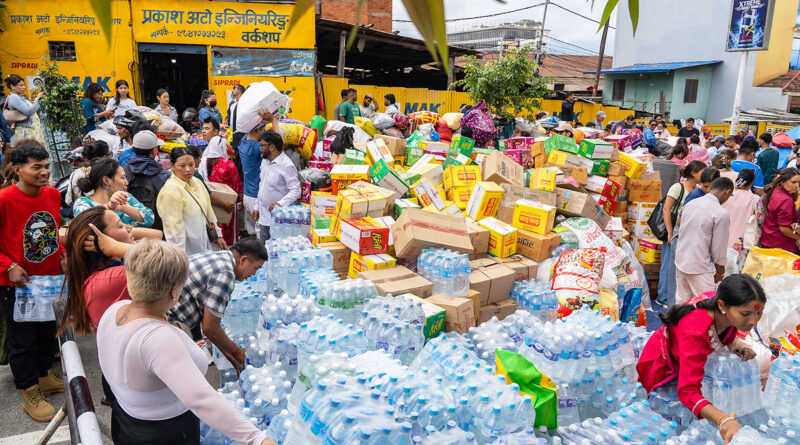
Caritas is focusing on providing aid to those who have been displaced such as bringing them clothes, bed sheets, blankets, tarpaulins, tents, medicine, food and any other essential items. Their efforts have also been centered on providing medical aid, especially to pregnant women or mothers with young children.
Despite the mobility issues, Caritas already has “two, three trucks ready, with food items and non-food items to send to rural locations,” Sister Shrestha insisted.
An organisation that has had experience with natural disasters
Sister Shrestha noted that Caritas Nepal has already had experience with dealing with major natural disasters, as the country was hit by a 7.8-magnitude earthquake in 2015, which killed almost 9,000 people and injured 21,000.
This experience she says has helped them coordinate and collaborate with their various partners quickly in order to respond to this disaster. Caritas Nepal also has provincial and field offices across the country that were ready to mobilize and they have also received support from other Caritas branches.
Support through prayers
Sister Shrestha shared that she was grateful for all the concern, prayer and support that she has felt coming from across the world.
“Caritas Nepal is always grateful to the Catholic community or any organizations who help us and support us in our difficult times. I think that that is more than enough to encourage us to go ahead and to support the people,” she said.
“We are only afraid that we are not able to reach people but with everyone’s prayer and support we are ready,” she insisted.
Pic: Kathmandu, Nepal. 28th Aug, 2026. People donate supplies for those affected by the flash flood, in Kathmandu, Nepal, on Aug. 28, 2026. Those supplies would be transported to the flash flood-hit areas in Nepal for people in need. The death toll from devastating floods in Nepal has risen to 538, the National Disaster Risk Reduction and Management Authority said in a statement on Friday. Credit: Hari Maharjan/Xinhua/Alamy Live News
________________________